
-
 Karen Moss "Self-Portrait with Cat" (2014) © Karen Moss
Karen Moss (1944-2026)
A ReflectionThe news of Karen Moss’s passing brought me back to the fall of 2022, when I visited her “Wonder Home” (a name that seemed to me the most fitting) in Boston while preparing for Eccentric Vision: Works on Paper from a Private Collection, a show featuring works from her private collection that echoed the spirit of the Outsider Art Fair.
-
 "Hope Lutheran Church," Minneapolis, 2008, acrylic and relief ink on canvas, 36 X 24 in. © Carolyn Swiszcz
Minnesota Miracle
Carolyn Swiszcz's Magical LocalismSeventeen years ago, I hosted a solo exhibition by St. Paul, Minnesota-based painter and printmaker Carolyn Swiszcz titled Minnesota Miracle. Her depictions of the city’s landmarks, parks, and storefronts carry a subtly off-kilter quality, despite their contemporary designs and cheerful signs and banners. Through complex layers of painting, printing, cutouts, and collage, Swiszcz reimagines banal scenes and familiar places, uncovering unexpected pleasures within them. Yet her work never turns away from the reality she observes—reality as lived and inhabited by people, suggested through details such as tire tracks etched into frozen roads, capsized plastic chairs in a restaurant backyard, or a house window adorned with a hand-lettered “Happy Birthday” sign.
Why, then, does she call this unvarnished reality a “miracle”? The word seems to signal Swiszcz’s deep attachment to her city and its people, even though she is not originally from the region. As of this writing, social unrest in Minnesota continues to intensify, particularly following two civilians—both, coincidentally, 37 years old—who were protesting immigration crackdowns and were murdered by federal agents in front of fellow protesters and bystanders. When I asked Swiszcz how she was coping with the situation, she said she was finding small ways to help others.
Her response reminded me of a news story about a local shop handing out hot drinks and donuts to protesters enduring sub-zero temperatures. Swiszcz has created several works inspired by Granny Donuts, her favorite neighborhood shop—one that endured for generations before closing during the COVID pandemic. If free donuts can be understood as a small miracle, then perhaps a larger one lies in the towering corporate presences of Minneapolis, such as 3M and Target. The former, in particular, was a recurring subject in Swiszcz’s work.
What stood out most to me in the exhibition, however, was a painting depicting—beneath a brutally gray sky—a tedious tan building with a brown roof and a tall vertical structure that might be mistaken for a prison watchtower were it not for the elongated cross beside a large sign reading “HOPE.” This modest local church, rendered with somber restraint, exemplifies Swiszcz’s sensitive magical realism. It is also an emblem of warm localism—one I appreciate even more now, as I reflect on the harsh realities facing her state today.
-
 Melissa Shook, "Untitled (Krissy in her grandparents' home, Milford, Connecticut)," ca. 1968, gelatin silver print, 9 3/8 x 5 7/8 in 23.8 x 14.9 cm
A Mother’s Gaze
In a Space of Shared TrustAt this time of year, the holiday season often brings with it a heightened awareness of memory—family gatherings, inherited traditions, and objects passed down through generations. I find myself thinking about Krissy’s Present, Melissa Shook’s exhibition at Miyako Yoshinaga Gallery (December 2023–January 2024). The show felt inseparable from the season itself: intimate, reflective, and suffused with a quiet warmth shaped by time.
Shook’s most enduring subject is Krissy, her daughter and only child, born in 1965. Over the course of eighteen years, Shook photographed Krissy from early childhood through adolescence. These images function as both a maternal record and a personal reckoning. For Shook, photographing Krissy was not only an act of devotion but also a way of addressing the absence of her own mother, who died when Shook was twelve. That loss left a lasting rupture in her sense of being loved. While this subconscious longing may underpin Shook’s sustained attention to her daughter, she was careful not to burden Krissy with it, allowing her to grow freely and independently.
The exhibition’s sense of retrospection was heightened by the inclusion of personal objects—toys and Christmas ornaments from Krissy’s early years—displayed in quiet conversation with the photographs (installation image). The effect was deeply nostalgic and unexpectedly tender. These objects did not function as props or explanations, but as companions: material traces of a life once lived, echoing the emotional texture of the images themselves. Together, they created an atmosphere that felt especially resonant during the holidays, when family bonds and memories often come most sharply into focus.
As a single mother, Shook photographed her daughter with remarkable openness and care. At first glance, some images may surprise—particularly those in which Krissy appears nude. Yet through my conversations with Krissy, it became clear that these moments were experienced as entirely natural within the context of their shared home. The photographs do not perform vulnerability for the camera; rather, they reflect a space of trust, ease, and mutual understanding between mother and daughter. The body is neither sensationalized nor idealized—it is simply present, part of everyday life.
This sensitivity toward the body and toward self-representation becomes even more pronounced when viewed alongside Shook’s later work. In 1972, she began her daily self-portrait project, a sustained exploration of identity, appearance, and embodiment. Often photographing herself nude and incorporating performative gestures within domestic settings, Shook used the camera to question how female identity is shaped, seen, and claimed. In retrospect, it seems possible that this inquiry began earlier, within her photographs of Krissy. As Shook documented her daughter’s growth, she was also coming to understand her own role as a mother—perhaps even seeing herself reflected through the act of looking.
One photograph (featured above) from the exhibition remains especially vivid for me. Krissy, around three years old, stands on a table with her back to the camera, her body gently bent as her left arm reaches upward. The gesture suggests movement—almost a dance—caught mid-action. In the left background, a mirror faintly reflects her face and the echo of her motion, introducing a second, softer presence. Light pours in through a window, falling across Krissy’s body and animating the scene with quiet energy. The photograph feels alive with joy, curiosity, and freedom. In this moment, the viewer senses not only the child’s happiness, but also the mother’s attentive gaze—careful, loving, and deeply present.
What lingers most in Shook’s photographs is this maternal gaze, sustained by a shared space of trust. The images are intimate without being intrusive, emotional without becoming sentimental. They speak to the complexity of motherhood, to the act of witnessing another person grow, and to photography’s ability to hold love, memory, and time all at once. In the context of the holiday season, Krissy’s Present feels less like a retrospective and more like a gift.
-
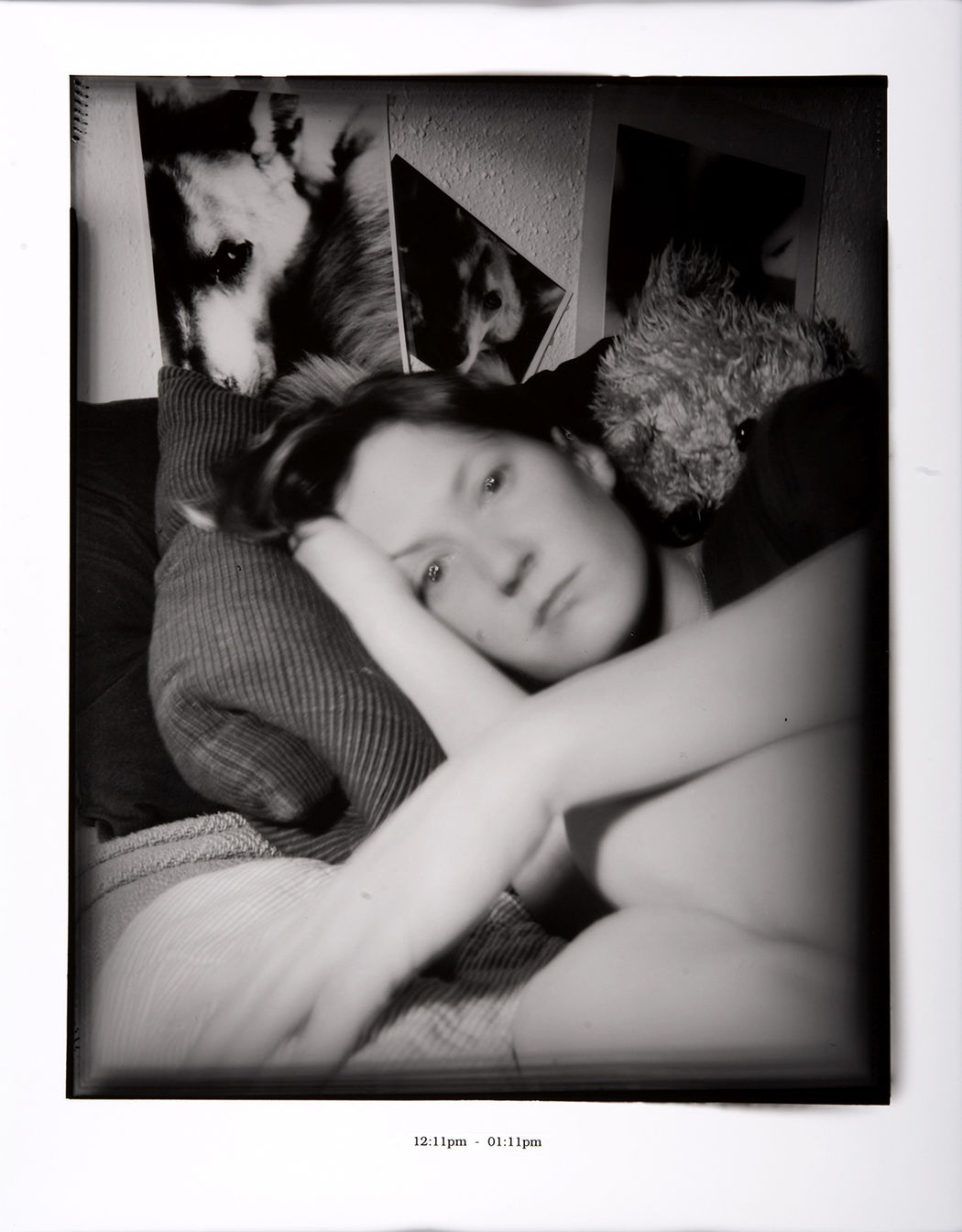 Ken Ohara, "with 924," 1998, gelatin silver print, 16 1/8 X 12 7/8 in / 41 X 33 cm
To be with Time
Ken Ohara: withWith, Ken Ohara’s 1998 series consists of one-hour-exposure portraits of strangers. Through the slow passage of exposure, the traditional expectations of portraiture—clarity, individuality, the decisive moment—dissolve into the stillness. While the outlines of a sitter's head and body soften and some details are lost, the portrait uniquely gains new dimensions. Around each sitter, lingering fragments of their world—a pillow, a wall, a shadow—offer quiet clues to who she/he is. Together, these portraits of a total of 123 form a collective meditation on time and presence, including the unseen artist behind the camera.
Ohara has always been deeply interested in time. His 1970s experiments, such as Diary/Self-Portraits (a pair of photographs taken per day, including one self-portrait) and 24 Hours (a self-portrait taken every minute for 24 hours), both look inward, tracing the shifting awareness of the self throughout the course of a day. But with feels like the inverse—an outward reflection on others. Here, he opens the camera for an hour and releases the photographer’s usual control over the moment. Normally, the photographer decides when to press the shutter, freezing a split second of intention and authorship. Ohara instead embraces uncertainty. The camera simply remains open, and whatever happens within that hour—boredom, stillness, daydream—is allowed to unfold on its own.
When I met the artist, he spoke often about Eastern philosophy, and I began to understand how deeply it informs his work. I think of with through the idea of wu wei—the Taoist notion of effortless action, or harmony with the natural flow of events. In these portraits, there is no attempt to impose will or control. Instead, Ohara practices a kind of photographic surrender. Time, light, and the subject’s own presence become the real collaborators. The result feels both spiritual and human: an image that holds traces of being, not through representation but through duration. The work invites us to reflect on the nature of existence itself—how our sense of identity is shaped by the passage of time, and how stillness can also be a form of movement.
I’m especially drawn to this image of a woman resting on a bed, surrounded by the softness of her own world. Even though her face is blurred, her gaze remains direct, almost confrontational. She looks both at us and beyond us, caught between presence and disappearance. I find myself wondering what she thought about during that hour—was she bored, contemplative, or simply hanging in that suspended time? The stuffed animal beside her and the photographs of dogs on the wall transform the frame into an intimate interior, filled with small, tender details. Even as her face and body seem to fade away, it feels personal and real, as if we’re being allowed to share her solitude.
To me, with is not only a portrait of its subjects but also of the artist’s quiet philosophy. It reveals how photography can be less about capturing and more about being with others, with time, with the world as it unfolds moment by moment.
-
 Untitled (Datura Flower AFD-F79), 1998, Ataraxia pigment transfer print on melinex, 24 x 19 1/8 in / 61 x 48.6 cm
Lit from Within
Datura by Bianca SforniWhen I first encountered this photograph of a datura flower, I was struck by its quiet power. The flower glows in electric shades of magenta and violet against a pitch-black background, as if it were lit from within. Its form feels both fragile and commanding—the stem stretches like a beam of light, while the petals open with a sensual, almost otherworldly energy. To me, the image carries a stillness that is deeply tempting, as if the flower is quietly inviting us closer.
-
 Hitoshi Fugo, On the Circle #21, from the series On the Circle, 2010, Gelatin Silver Print
Lonely Constellation
Work by Hitoshi FugoHitoshi Fugo, a Japanese photographer, alludes to the celestial heartbreak of the story of Tanabata within his photograph, On the Circle 21, in which a young woman wrapped in stars, similarly to a lonesome constellation, hunches upon the Circle that Fugo photographs upon. On the Circle refers to a circle of artificial grass that Fugo stages various subjects and scenes, from generational portraits to nature's changing seasons; On the Circle 21 strikes me as a darker interpretation of the Tanabata love story.
-
 Mikiko Hara, Untitled, from the series Agnus Dei, 1998, chromogenic print
The Wonders of Flora
Work by Mikiko HaraJune is the beginning of the East Asian monsoon season. Although it's hot and humid and quite unpleasant as I used to experience while living in Japan, the plants and flowers grow strongly and their scent penetrates deep into the atomosphere. The lush colors of leaves and flowers give feed your eyes.